



First in class
For students at the Edward Via College for Osteopathic Medicine, it’s not just about the medicine, there’s a mission, too
AUGUST 18, 2011 10:05 a.m.  (0)
(0)


The mill’s 182-foot smokestack, the tallest structure of its kind in South Carolina, is preserved on the site as a reminder of what had been the world center of the textile industry.
“The students love it,” said William King, associate vice president of student services. “It is a tie to history.”
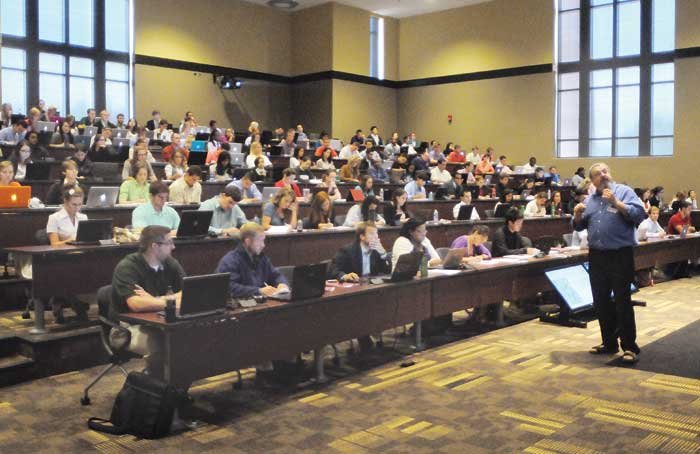
The symbolism of being in the first class of a medical school where the Spartan Mills once provided jobs for generations only to collapse into bankruptcy in 2001 was not lost on Matthew Fisher of Union, a member of the inaugural class.
For Fisher, VCOM’s mission to educate doctors for rural communities relates directly to the decision to place the college on a site that represented “the big economic downfall of the textile industry.”
To a person, the five students interviewed by the Journal on the first day of classes Aug. 11 said VCOM’s focus on primary care for underserved populations and the osteopathic emphasis on preventive medicine were attractions that brought them to the new school.
“I really like the aspect of preventive medicine and educating patients,” said Savannah Schultz of Charleston, a graduate of nearby Wofford College. “That’s really important, and a lot of doctors skip over that part.”
“Focusing on the person instead of the patient,” is the way Ashley Howard of Taylors, a Bob Jones University graduate, put it.
VCOM’s health-screening missions into Appalachia and to its three clinics in Latin America during school breaks were another draw.
“They allow you to take mission trips in your first year, which is kind of different from most schools,” said Cate Raff of Greenville.
“Like most everyone here, the mission is the big attraction – being able to expose yourself to something you otherwise wouldn’t be able to see,” said Adam Boiter of Greenville, a graduate of Anderson University.
With Diploma Comes Debt
Medical school is not cheap. Tuition at VCOM is $37,000 a year, about the midpoint between the median of $28,700 for public medical schools and $46,900 for private schools; other expenses add $20,000 to 25,000.
Because VCOM is accredited, students qualify for low-interest federal Stafford loans and “will borrow about $65,000 a year,” King said. According to the Association of American Medical Colleges, med school students at private institutions are graduated with a debt of $180,000 on average.
The Spartanburg campus encompasses 20 acres with entrances off Magnolia and College streets. The building has 70,000 square feet on three floors. The investment is in excess of $26 million, “and we funded it ourselves,” said King.
To be ready for classes in early August, VCOM pursued “a very aggressive time line to get this building complete,” said Dr. Timothy J. Kowalski, vice dean. “Thirteen months ago, this was a flat piece of property, and now we have a beautiful medical school.”
Workers are still completing landscaping and finishing the third floor where labs and a simulation center are to be. Kowalski said that everything will be done by October.
Why Not Spartanburg?
A psychiatrist who was graduated from the Michigan State University College of Osteopathic Medicine, Kowalski joined VCOM in July 2010 as the resident administrator at Spartanburg. He had retired from the South Carolina Department of Mental Health.
Founded in 2001 with the first class in a new campus at Blacksburg, Va., in 2003, VCOM’s mission “is to prepare globally minded, community-focused physicians for the rural and medically underserved areas of Virginia, South Carolina, North Carolina, and to improve human health, especially of those most in need.” It is nonprofit.
Spartanburg Regional Hospital became one of the 20 hospitals used by VCOM for rotation for its third and fourth year students, and that relationship led to the Spartanburg branch.
Kowalski said about four years ago the leadership of VCOM and the hospital were meeting to discuss starting an emergency medical residence, the “VCOM leadership shared that they were considering building a branch campus in North Carolina around the Charlotte area or in South Carolina.”
“Why not consider us?” was the response from the Spartanburg team, Kowalski said, and “in a very short period of time a consolidated group was offering an option for Spartanburg.”
“Being we wanted to be in the Carolinas and because there was such a warm welcome here, it was a natural fit,” said King.
Helping the Disadvantaged
Kowalski said the students at Spartanburg “were selected for their sense of altruism and for their motivation that parallels ours. Many are interested in primary care, serving the underserved, and in our missions in Latin America and Appalachia.”
He said VCOM is establishing relationships with St. Luke’s Free Medical Clinic and Church Builders in Spartanburg and similar organizations in Greenville to “set up health screening experiences for our students.”
Kowalski said VCOM also is working to create residency rotations at area hospitals in addition to Spartanburg Regional. Greenville Hospital System, which is in the process of creating its own medical school, apparently has declined to accept VCOM students.
“We had the opportunity to visit with the dean of that medical school. It was a very cordial visit, and certainly we respect that they are putting their time and effort into rotations for their students,” Kowalski said.
VCOM also is working to create a research consortium to “collaborate with the basic science faculties from Wofford, Converse, USC Upstate, North Greenville, Presbyterian College and Anderson University.”

JANUARY 5, 2012 2:06 p.m. (6)
OCTOBER 7, 2011 10:03 a.m. (0)
AUGUST 18, 2011 10:26 a.m. (0)
| Comments |
|
3.26 Copyright (C) 2008 Compojoom.com / Copyright (C) 2007 Alain Georgette / Copyright (C) 2006 Frantisek Hliva. All rights reserved."


Business Licenses
City Elected Salaries
City Salaries
College Crime Report
County Elected Salaries
County Salaries
Court Dockets
Crime Blotter
Death Row
Drug Money
Executed
Expulsions
Family Court Filings
Lottery Money
Most Wanted
Nursing Homes
Out of School
Suspensions
Pardons
Parole Hearings
Political Contributions
Recent Recalls
Restaurant Inspections
SC DOT Cameras
School Profiles
School Salaries
Searchable Zoning Map
Sex Offenders
State Public Salaries
State Staff Salaries