


Med school becomes No. 136
Greenville Hospital System, USC earn preliminary approval for The University of South Carolina School of Medicine – Greenville, joining the ranks of the nation's 135 other medical schools
OCTOBER 7, 2011 10:03 a.m.  (0)
(0)


The University of South Carolina School of Medicine – Greenville had earned preliminary approval — the biggest hurdle in the effort to expand doctor training in Greenville.
 Youkey, the dean of what is now the nation’s 136th medical school, started emailing. Mike Riordan, president and chief executive officer of the Greenville Hospital System. Spence Taylor, the medical school’s senior associate dean for academic affairs and diversity. Harris Pastides, president of the University of South Carolina. Michael Amiridis, USC provost.
One by one, in various parts of the state and the world they learned the intense two years of planning and the precarious trek through South Carolina’s oftentimes fractured political world had paid off.
The Liaison Committee on Medical Education, an arm of the American Medical Association that handles the accreditation of medical schools, had blessed the unusual collaboration between the University of South Carolina and the Greenville Hospital System.
Taylor was in Boston’s Toro Restaurant and starting dinner with 25 other members of the American Board of Surgeons, who had spent the day testing the nation’s next group of surgeons. Taylor saw the email, told the people sitting closest to him the news and the next thing he knew Ken Sharp, chief of surgery at Vanderbilt University, was announcing the news to a great ovation.
“It was surreal,” Taylor said.
Riordan called trustees and other folks instrumental in the process, then toasted with a bit of Jameson.
“This is historic for us,” Riordan said.
The most immediate effect for school officials involves recruiting – students and faculty. Besides Youkey and Taylor, the school has six employees, including three who will be among the 22 to 25 faculty members teaching the basic sciences.
“Four or five of us quit our jobs with no guarantee,” said Taylor, who stepped down as chief of surgery at GHS to develop what became a 1,500-page document for the liaison committee that detailed every facet of the new school from curriculum to physical plant to finances.
He also managed to convince Lynn Crespo to leave her job as assistant dean of undergraduate medical education and professor of pharmacology at the University of Central Florida. He said this was key because she had already helped start two medical schools including Central Florida.
She is an associate dean at the Greenville medical school and helped shape a curriculum that tips medical education on its head with its focus on integrating various subjects from the first year and on team building. Students will train alongside pharmacists and nurses and other specialties.
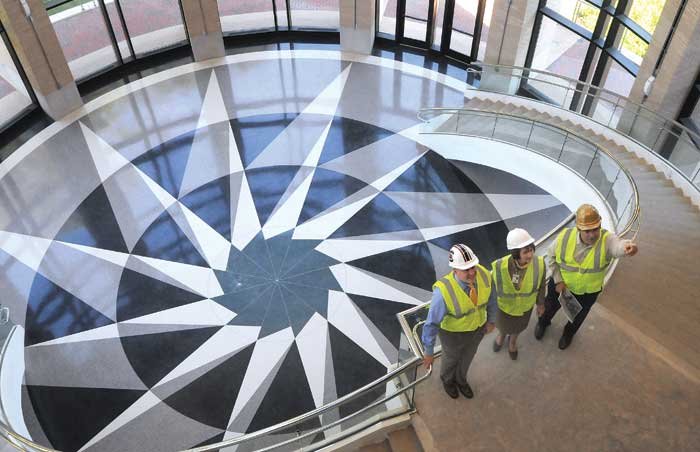
Riordan said one of the first responsibilities of the first class will be to decorate an unfinished common area in the medical school building, which until now had been an empty building adjacent to the hospital system’s Grove Road campus.
They’ll be given a budget to work with and expected to work as a team.
“Some will be part of a business enterprise – a physician’s office is a business,” Riordan said. “There are all sorts of ways to incorporate learning.”
Student recruitment began almost immediately Tuesday night. Taylor said emails went out to all the pre-med advisors in the state. The application piece of the medical school’s website went live.
Prospective students have inquired, but before Tuesday school officials could not recruit. They will be looking for 50 students in the inaugural class, increasing the number each year to reach 100 first-year students in year four.
Amiridis said the competition between the Greenville school, the USC School of Medicine in Columbia and the Medical University of South Carolina in Charleston will benefit each.
“It’s important for all three programs to be able to articulate strengths,” he said.
MUSC’s strength is basic science research. The University of South Carolina in Columbia specializes in education, most especially its ultrasound curriculum, which is nationally known. GHS wants to bring health care delivery.
“A different type of student will be attracted to each,” Amiridis said.
The relationship between USC and the hospital system offers a new paradigm in financing a medical school. The brunt of the burden falls on the hospital system, which expects to spend between $3.5 million and $3.7 million during the next decade, much of which is the cost of building construction. The hospital system already spends about $20 million educating third- and fourth-year students.
USC’s contribution will be the tuition paid by students. This year tuition is $29,948, and likely to rise again by the time the first students arrive in Greenville next August. Tuition has increased 9.9 percent in each of the past two years. That would bring in less than $2 million in the first year.
A key component for the hospital – but not required to make the budget – will be fundraising from individuals, foundations and other private organizations. Officials from the university and the hospital system promised no state funds would be used as they battled back the challenge from Lowcountry legislators and MUSC administrators about the new school draining precious state resources.
In Columbia, 20 percent of the medical school’s almost $70 million budget comes from state funds.
Riordan said a committee will be formed shortly to focus on fundraising. Naming rights will be available for atriums, endowed chairs, the building and the medical school itself.
In addition, school representatives will look for opportunities to establish scholarship programs for students.
Riordan, who will become Greenville Chamber of Commerce president in January, said the medical school will benefit the local economy and one day could spur development of medical-related businesses along the I-185 corridor and retail and other business near the campus.
The hospital system gets the added benefit of being able to recruit and retain highly capable physicians.
“There’s a tendency for teachers to stay at the top of their game,” he said.
Taylor said he thinks people generally do not understand how big the impact the medical school will have on the Upstate.
“It immediately puts us in the top tier,” he said.
From here, members of the liaison committee will be back in two years to reassess the progress. If all goes well, provisional accreditation will be given. Two years after that, another visit and full accreditation.
“This is once in a lifetime stuff for me,” Riordan said.

AUGUST 18, 2011 10:05 a.m. (0)
Reading, it's always on their mind
SEPTEMBER 15, 2011 1:40 p.m. (0)
SEPTEMBER 15, 2011 12:15 p.m. (0)
| Comments |
|
3.26 Copyright (C) 2008 Compojoom.com / Copyright (C) 2007 Alain Georgette / Copyright (C) 2006 Frantisek Hliva. All rights reserved."


Business Licenses
City Elected Salaries
City Salaries
College Crime Report
County Elected Salaries
County Salaries
Court Dockets
Crime Blotter
Death Row
Drug Money
Executed
Expulsions
Family Court Filings
Lottery Money
Most Wanted
Nursing Homes
Out of School
Suspensions
Pardons
Parole Hearings
Political Contributions
Recent Recalls
Restaurant Inspections
SC DOT Cameras
School Profiles
School Salaries
Searchable Zoning Map
Sex Offenders
State Public Salaries
State Staff Salaries