



Board could name new superintendent Saturday
Three finalists include two from South Carolina, one from Indiana
MARCH 22, 2012 12:40 p.m.  (0)
(0)


Read more about the finalists here
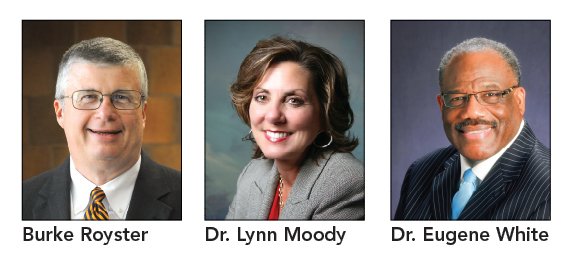
Members of the Greenville County school board will meet beginning at 9 a.m. to choose from three finalists to replace Dr. Phinnize Fisher – Burke Royster, the man who has handled the school district’s day-to-day operations for the past six years as deputy superintendent; Dr. Lynn Moody, who has led one of South Carolina’s best school districts in York District 3; and Dr. Eugene White, a leading figure in national education circles who wrote a book on leadership without excuses.
White has led Indianapolis Public Schools for six years.
During his tenure, the district’s graduation rate improved from an abysmal 45 percent to 65 percent.He said enrollment has decreased in the district, but the students who move out are often the ones who come from a higher economic status.
“If you look at the needs and academic performance of the students who stayed, I believe what we did is even more impressive,” he said.
White said increased choices such as magnet programs, dual credit programs affiliated with Indianapolis-area colleges and flexible schedules helped with retention.
“We want to provide as many chances as we can to prevent excuses,” he said.
White said if he is chosen superintendent, he believes Greenville County Schools can have “unparalleled” success.
Moody, who has led York District 3 for six years, said what she does best is build community. She wants to hear ideas from everybody, especially when they don’t have the same view as she does.
“I tell my staff to leave titles at the door,” she said. “I don’t need a group of yes men. That’s where you get in trouble.”
She said big decisions take time, and she believes in giving those decisions as much time as they deserve. But she can admit when she has made a mistake.
Early during her tenure in Rock Hill, she was told the district’s after-school program was losing money. She decided to let the business community offer programs instead. The decision created a backlash and Moody rethought it. Some changes were made to the district’s after-school program, and now the program is making more money than ever before. She also said implementation of a $25 academic fee in the height of state budget cuts didn’t work either because it took too much administrative time.
“I do believe in piloting things and trying things,” she said.
Royster has led the school district’s day-to-day operations since 2005. He said his familiarity with the district would allow him to start working on things to improve the district immediately.
“There is no learning curve,” he said.
Royster led the district’s efforts to implement cost saving measures during a 3-year period of revenue reductions exceeding $70 million. He also coordinated the development of the district’s long-range facilities and capital-improvement plan and is playing a key role in the development of an Early College program.
The salary of the new superintendent will be negotiated. The current superintendent base salary is $221,700. Greenville County Schools is the 49th largest school district in the nation.
Although his teen mother had dropped out of school in the eighth grade, there was no question Dr. Eugene White was going to graduate from high school.
“She was determined that we were going to get the education she didn’t get,” White told The Indianapolis Star for a story marking his fifth year as superintendent of Indianapolis Public Schools. “So, in my house, we never even comprehended not going to school.”
White, who grew up in Alabama, was the first person in his family to graduate from high school. He is one of three finalists for the Greenville County Schools’ superintendent job.
White is also a finalist to lead the Mobile County School District in Alabama. That district will interview candidates beginning on Monday.
White told The Star that his high school science teacher, Lester Mason, had the biggest influence on his life.
“He wouldn’t let circumstance, he wouldn’t let poverty, and he wouldn’t allow negativism to defeat what he needed to do,” White told the paper. “He was really concerned with providing the best opportunity for these children of poverty and segregation, and he knew what we could be.”
Years later, Mason told White, “You never know.”
When White asked what that meant, Mason told him, “Well, you never know who’s in your classroom, so you have to teach them very well, because you don’t know who you’re turning out.”
White, who was career-leading scorer for the Alabama A&M University basketball team and a member of the school’s athletic Hall of Fame, went on to become the first African-American high school principal in Fort Wayne, Ind.
He served 11 years as superintendent of the Metropolitan School District of Washington Township in Indiana before being named leader of Indiana’s largest school district, Indianapolis Public Schools.
He has been named Indiana Superintendent of the Year twice – in 2002 and again in 2009. He was named the 2007 National Association of Black School Educators Superintendent of the Year and received the 2006 Modern Red Schoolhouse Distinguished Service Award.
Back in 1992, Redbook magazine named him a “visionary leader” as principal of one of America’s Best Schools.
White authored the book, “Leadership Beyond Excuses: The Courage to Hold the Rope.” He co-authored a second book, “Leading Schools of Diversity.”
White has said educational headhunters have contacted him multiple times over the years, but the Greenville and Mobile jobs were the first for which he applied. He said he wants to move back to the South.
When White took over at IPS, the district with the most poverty among the 11 school districts in that county, the school system had an abysmal graduation rate of 45 percent. It is up to 65 percent.
Burke Royster
It’s probably no surprise that Burke Royster chose to go into teaching. He comes from an education family.
His father spent 16 years as superintendent of Anderson County School District 5. His mother was an elementary school classroom teacher and media specialist. And while he had the opportunity to try other things, he felt called to follow his parents’ footsteps into education.
“It’s not just a career. It’s not just a job,” he said. “I think education is something you’re called to do.”
Royster, Greenville County Schools’ deputy superintendent, is one of three finalists for the district’s superintendent job. He has been in charge of the day-to-day operations of Greenville County’s public schools since 2005, and said it’s this thorough knowledge of the district that sets him apart from the other two candidates.
“There is no down time, no learning curve. Quite simply, I strongly believe that I have the background, the knowledge and the experience to be the person to continue to move the district forward.”
While he liked being in the classroom – he was a seventh- and eighth-grade math and social studies teacher and a JV football coach at Starr-Iva Middle School in Anderson County – Royster decided he could affect more students as an administrator.
“I saw early on I could have a direct influence on the 150 students I taught in five classes a day or I could have an effect on an entire school or district. It was an opportunity to expand my ability to be a positive influence,” he said.
Royster, a Clemson grad who is working on his doctorate at the University of South Carolina, served as assistant principal at Monaview Elementary and Northwestern High School in Rock Hill and as a principal at Waccamaw High in Pawley’s Island and Seneca High.
In 1999, he was named assistant superintendent of the School District of Oconee County. He came to Greenville County in 2005.
Royster said the school district’s greatest asset is its people: students, teachers, administrators, parents and community. The district can improve in all areas, Royster said, but the one area in need of greatest focus is the delivery of instructional services. While innovative instructional practices are being used in Greenville County schools, there should be more, he said, and those innovations need to be shared and replicated.
Royster said his knowledge of the district and the community would allow him to focus immediately on improvement.
“With that knowledge, the hope is you wouldn’t go too often down the wrong road,” he said. “The better you know the system, the better it helps you gauge where changes should be made. There’s no system or business that can’t be improved, but it’s important to know which changes need to be made.”
Dr. Lynn Moody
When Dr. Lynn Moody was in middle school, the entire student body decided to walk out one day to protest the principal’s decision not to allow seniors to go to Washington D.C. because they had gotten into a snowball fight.
A television crew covering the protest caught her exit on camera.
Seeing their daughter on the news didn’t go over well with Moody’s parents, both educators. Her mother told her to remain in her seat from now on, even if the school was on fire.
But today’s students are way different from students in Moody’s student days, the middle school protester-turned- superintendent of York District 3 said. The way schools and teachers reach them and educate them must be different, too.
Innovation is key, said Moody, who is one of three finalists for the Greenville County Schools’ superintendent job.
Moody has led York 3 in Rock Hill, considered one of the state’s best school districts, since 2006.
Those who have worked with Moody say her strengths are building community support and thinking outside the box to improve education.
She has held monthly morning chats in the district’s middle schools and at a downtown Rock Hill bagel shop on the city’s northwest end, to give people who otherwise might not have a chance the opportunity to ask questions and share ideas.
Two years ago, she sought out “positive deviants” – people she says question the way things have always been done and can think of fresh and unusual ways to reform the school system.
Moody is a part of the League of Innovative Schools, a group of 35 school districts sharing ideas about using technology successfully and working to find new ways to get promising technologies into the classroom. She said some classrooms in her district are piloting a program that allows students to use cell phones during class for instructional purposes.
But Moody said she’s not afraid to admit she made a mistake or that a program doesn’t work. “If it turns out wrong, I’m good with saying let’s do something different.”Moody says building relationships is what she does best.
She spent nine years in the classroom, including time as an agriculture teacher, before landing what she called her dream job at the time, career and technical education director for the Wake County School District in North Carolina. That district has twice as many students as Greenville does.
From there, she moved to Rock Hill to become York District 3’s associate superintendent of planning. Her first job was working on a student reassignment necessitated by the district opening its first new high school in three decades. For the first year of the project, she didn’t allow community members on the reassignment committee to see a map, she said.
She assumed the superintendent’s job less than four years later.

Fisher: ‘It’s about the children’
APRIL 19, 2012 10:48 a.m. (0)
Divided school board names Royster superintendent
MARCH 29, 2012 11:18 a.m. (0)
Gordon "lived a life that mattered"
MARCH 1, 2012 12:23 p.m. (0)
| Comments |
|
3.26 Copyright (C) 2008 Compojoom.com / Copyright (C) 2007 Alain Georgette / Copyright (C) 2006 Frantisek Hliva. All rights reserved."


Business Licenses
City Elected Salaries
City Salaries
College Crime Report
County Elected Salaries
County Salaries
Court Dockets
Crime Blotter
Death Row
Drug Money
Executed
Expulsions
Family Court Filings
Lottery Money
Most Wanted
Nursing Homes
Out of School
Suspensions
Pardons
Parole Hearings
Political Contributions
Recent Recalls
Restaurant Inspections
SC DOT Cameras
School Profiles
School Salaries
Searchable Zoning Map
Sex Offenders
State Public Salaries
State Staff Salaries