



Keeping up with the pandas
A day in the life of a Greenville Zoo vet
SEPTEMBER 29, 2011 11:08 a.m.  (0)
(0)


Despite surgery, Joey’s scrotal tumor keeps coming back. And with the location of the mass, it’s unlikely surgeons could get all of it and enough tissue surrounding it to prevent it from just growing back again.
Five radiation treatments could buy Joey some time, but just how much is uncertain.
The oncologist has never done radiation on a lemur before.
“Unfortunately, we’re just buying him more time,” said Miller, the Greenville Zoo’s full-time veterinarian since January 2010. “It’s a judgment call because we only want to buy him quality time. If a week of feeling off can buy him six to 12 months of quality time, it’d be worth it.”
Miller works in a nondescript cinderblock building in the back of the zoo, where she monitors the health of the zoo’s 200 animals, ranging from the tiniest of reptiles to the zoo’s most famous animal, Joy the elephant.
During the zoo’s accreditation in 2009, the American Zoological Association said one of its weaknesses was veterinary care, said Greenville Zoo Director Jeff Bullock.
When the zoo was restructured in 2009, a full-time veterinary position with administrative duties was created and Miller, who had worked as the zoo’s part-time vet since 2007 while working at a Simpsonville veterinary practice that treated farm animals, birds and reptiles in addition to dogs and cats, was hired.
Miller originally planned to go to medical school at UCLA so she could be a pediatrician.
She had a chance to volunteer at an animal emergency clinic as well as a pediatric clinic while she was attending Clemson.
“It was so sad dealing with sick children,” she said.
During her senior year at Clemson, she switched from pre-med to pre-veterinary so she could combine her love of science with her love of animals.
“I read all the of the James Herriot books growing up and there are pictures of me with a goat when I was little,” she said.
Miller had parakeets, green lizards and a cat named Spooky as pets. Her dad promised her she could get a dog when the family moved to Greenville from California when she was in middle school. She said she never got the dog.
To get even, Miller gave them an epileptic Dalmatian that came to her veterinary clinic to be put to sleep. Her parents had the dog for 10 years.
“I turned them into dog people,” Miller said.
Although she switched the focus of her medical career, Miller said there is one big similarity between them – patients can’t tell her what’s wrong.
“That’s one of the challenges,” she said.
And working with exotic species of the zoo collection adds a dimension to that challenge, she said.
Joey’s treatment is an example.
She and Dr. Ivan Martinez, an oncologist from Upstate Veterinary Specialists, are giving the lemur, a black and white tree-climber, a series of four melanoma vaccines designed for dogs. The vaccines are made from human melanoma and help a dog build up resistance to the disease.
The vaccine costs $1,200.
Without the radiation, Miller and Martinez said it would probably be two months before the tumor starts affecting Joey’s quality of life. It’s an option the zoo’s treatment team will have to consider carefully.
When research is limited on a species, Miller treats an animal based on the larger animal classification it belongs to. Elephants, for instance, are similar to horses digestively.
She conducts Google searches and consults a zoo vet list-serve. And, she said, when all else fails, she calls doctors who treat humans.
She’s had a cardiologist come out to do an electrocardiogram on one of the zoo’s orangutans and a dentist do a root canal on one of the leopards.
Treating animals at the zoo has gotten a bit easier, thanks to donations from Friends of the Zoo, she said. Friends donated $25,000 for a new anesthesia machine and a surgery monitor. The zoo also purchased an ultrasound and an x-ray machine.
The zoo clinic’s treatment area will be expanded and a small surgical suite added so Miller can do sterile surgeries, said Bullock. The second phase of improvements will add more quarantine holding capacity.
Once the improvements are made, the zoo will be able to do most all medical treatment of the animals in-house, Bullock said.
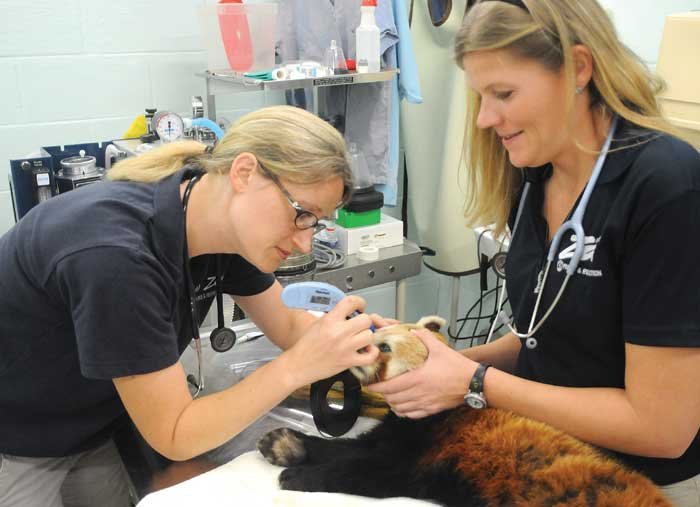
After Joey’s exam, Miller performed a yearly exam on a female red panda, Scarlet.
Scarlet has a cataract on her sightless left eye. On this day, Miller was going to use a digital thermometer-like device to check Scarlet’s eye pressure. If it was too high, the cataract would have to be removed.
But Scarlet had different ideas.
A shot of anesthetic didn’t put her under enough so Miller put her in a homemade “gas chamber,” a plastic Rubbermaid storage box with a small hole cut in the side just big enough for the hose from the aesthetic gas machine.
A few minutes later, Scarlet’s head dropped. It was time for her exam.
The eye pressure tested fine, but x-rays made her heart look enlarged. An ultrasound showed no problem.
Miller did find fleas, a first for her at the zoo.
She texted zoo vet friends in Birmingham and Indiana to see if they knew whether it was safe to give cat Frontline to a panda. A Google search revealed nothing.
“I know you can’t give Frontline to rabbits because it will kill them,” she said.
A quick look on the zoo vet list-serve revealed other zoos had success with the flea preventative medicine on red pandas.
Then, it was off to vaccinate the giraffes against tetanus. After months of training by the giraffe’s zookeeper, one of them allowed Miller to deliver the vaccine by hand. The other had to be darted.
“I love the variety,” Miller said, walking back to the zoo clinic. “And the challenge.”
Later that day, she would examine an opossum.
Her day ended by vaccinating a copperhead.

JANUARY 12, 2012 11:27 a.m. (0)
Work on zoo plan could start in October
SEPTEMBER 22, 2011 11:17 a.m. (0)
City zoo consultant worked on Disney park
JUNE 30, 2011 11:25 a.m. (0)
| Comments |
|
3.26 Copyright (C) 2008 Compojoom.com / Copyright (C) 2007 Alain Georgette / Copyright (C) 2006 Frantisek Hliva. All rights reserved."


Business Licenses
City Elected Salaries
City Salaries
College Crime Report
County Elected Salaries
County Salaries
Court Dockets
Crime Blotter
Death Row
Drug Money
Executed
Expulsions
Family Court Filings
Lottery Money
Most Wanted
Nursing Homes
Out of School
Suspensions
Pardons
Parole Hearings
Political Contributions
Recent Recalls
Restaurant Inspections
SC DOT Cameras
School Profiles
School Salaries
Searchable Zoning Map
Sex Offenders
State Public Salaries
State Staff Salaries