



Growers predict a fine peach season
Mild winter gives Upstate a 10-day headstart on competition this year
MARCH 22, 2012 1:16 p.m.  (1)
(1)


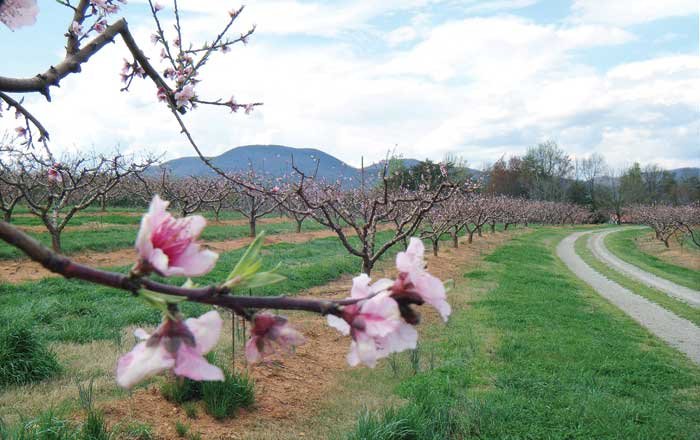
The borderland between Greenville and Spartanburg counties is alive with pink blossoms and Scenic Highway 11 from the base of Hogback Mountain to Cherokee County is a carpet of emerald green and pink.
This year’s mild winter should give growers like James Cooley, located outside of Chesnee, a leg up on the competition this year, said Desmond Layne, Clemson University peach specialist.
This year’s crop will come in 10 days to two weeks earlier than normal, Layne said.
“That gives the growers here the first shot at the market for fresh fruit on the grocery store shelves,” he said. “That’s important because it enables them to position themselves and get the best prices for their fruit.”
South Carolina is the nation’s second largest producer of peaches, slightly ahead of Georgia, which is number three, and far behind California, which produced about 65 percent of total U.S. peaches.
“Hard data on South Carolina’s peach crop is difficult to get,” Layne said. “A major factor is the growers are reluctant to give away too much information. Coupled with the fact that we’ve (at Clemson) not had anyone dedicated to actually going out and gathering information for 10 years, you can’t put too much faith in the data that’s out there.”
However, Layne said his own observations from traveling to the peach producers around the state find that the Ridge region of the Midlands – Aiken, Edgefield, Saluda and Lexington counties – produces about 50 percent of the total crop. The Upstate – Greenville, Spartanburg, Cherokee and Gaffney counties – accounts for about 30 percent and the coastal plain turns out about 20 percent of the total.
Broadly speaking, the South Carolina peach crop is worth between $40 and $60 million a year, with the bulk of that going to the big growers in the Ridge region.
Spartanburg’s growers concentrate heavily on the basket market, selling their fruit from stands clustered around major highway intersections and up and down Highway 11.
“But they also sell their fruit to markets as far away as Ohio,” Layne said. “They usually ship in baskets versus the half-bushel (cardboard) boxes used by the growers in the Midlands.”
South Carolina growers concentrate on quality, Layne said. “The eating experience is everything in the fresh fruit market. California peaches are generally bigger and have really good color. The growers out there concentrate on varieties that have those characteristics, but the eating experience generally isn’t as good.”
Because of the distance, California fruit has to be shipped to reach eastern markets and is generally picked earlier than fruit would be in South Carolina, Layne said.
“The peaches tend to be harder and have lower sugar content,” he said. “They look good, but to an uneducated consumer the eating experience with California fruit leaves a lot of people cold.”
That’s not a problem with South Carolina fruit in general, and for growers in the Upstate in particular, the experience is everything, Layne said.
“A smaller grower with 125 to 150 acres of trees can afford to wait longer to pick,” he said. “This raises the taste factor considerably since the peach ripens more naturally. There is also the smell and package appeal, too.”
Tree-ripe fruit just looks better. The smell from a Highway 11 fruit stand can hit a consumer as soon as he steps out of the car, setting salivary glands to working overtime.
“Of course there are still a number of things that could affect this year’s crop,” Layne said. “A freeze seems to be a distant possibility right now and once the trees get out of the bloom stage they are far less vulnerable. Other factors that could have severe local impacts are things like hail damage, or disease. Those are the kind of things that every peach farmer faces and they seem to relish the challenge.”
Check http://www.clemson.edu/extension/peach/ for the latest information on the state of the crop this year.

| Comments |
|
|
||||||||
3.26 Copyright (C) 2008 Compojoom.com / Copyright (C) 2007 Alain Georgette / Copyright (C) 2006 Frantisek Hliva. All rights reserved."

3 resign from Greenville disabilities board
MAY 11, 2012 8:40 a.m. (42)
New technology keeps hearing-impaired 'in the loop'
MAY 11, 2012 8:45 a.m. (1)
Greenville aims to become a technology hub
MAY 11, 2012 9:02 a.m. (0)
MAY 11, 2012 8:52 a.m. (2)
Lawmakers rush to clean up election mess
MAY 11, 2012 9:00 a.m. (0)

Business Licenses
City Elected Salaries
City Salaries
College Crime Report
County Elected Salaries
County Salaries
Court Dockets
Crime Blotter
Death Row
Drug Money
Executed
Expulsions
Family Court Filings
Lottery Money
Most Wanted
Nursing Homes
Out of School
Suspensions
Pardons
Parole Hearings
Political Contributions
Recent Recalls
Restaurant Inspections
SC DOT Cameras
School Profiles
School Salaries
Searchable Zoning Map
Sex Offenders
State Public Salaries
State Staff Salaries