



Giants on the horizon
Nearly extinct for more than 50 years, the American chestnut tree is blooming again in the Carolinas
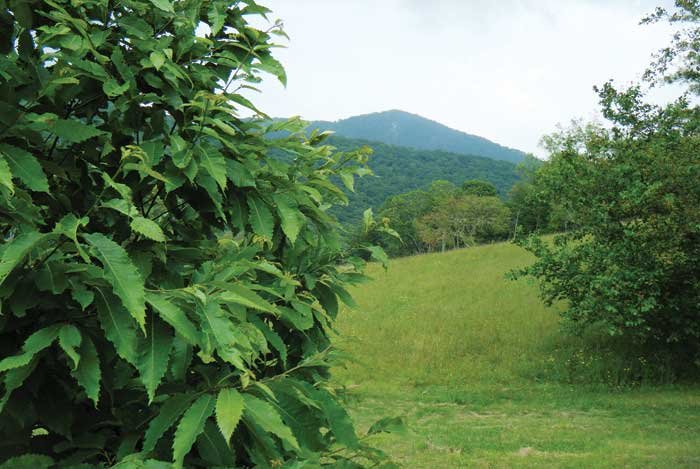
JUNE 21, 2012 10:01 a.m.  (2)
(2)


Judy Coker remembers the forest giants that once cloaked her father’s mile-high guest ranch above Maggie Valley in North Carolina.
“I was too young back then to think or know much about what was happening to the (American) chestnuts,” the 78-year-old Coker said. “It wasn’t until I was in my 60s that the impact of it all hit me.”
Today, Coker is pushing hard to bring the American chestnut back to the land where her father established Cataloochee Ranch in 1933.
“My father (Tom Alexander) was a forester. I think he’d like what we’re trying to do here,” Coker said last week.
Her dad and mom, who was known to the community as Miss Judy, purchased a large part of the present 800-acre property on top of Fie Top Mountain from Verlin Campbell, the potato king of Haywood County, in 1938.
The high mountains of the Appalachians were the last refuge of a species of tree that once made up 60 percent of America’s Eastern forest. Chestnut blight, an Asian import, killed the last of those trees – but before that another Asian disease, Phytophthora cinnamomi, which is similar to a fungus, killed them all in the lower elevations of their range.
The outbreak of blight started in 1900, and by the 1950s the last of the huge trees were gone. Phytophthora began much earlier, but was blocked from the high mountains by the fungus’ intolerance for cold: It cannot survive in areas that experience deep freezes in the soil.
The attack was thorough and final. Phytophthora kills the tree from the tip of its crown to the deepest root. Blight kills the tree to ground level.
“There were six huge trees on the property that I saw die, fall and rot away,” Coker said. “When you’re young it just doesn’t register … there are other things on your mind.”
One day, many years later, she was walking the grounds of her farm and encountered stump sprouts left over from those six monstrous chestnuts. The sprouts, small trees on their own, had matured enough to produce a few chestnuts. Coker retrieved the burrs.
“A chestnut burr actually hurts to hold in your open palm,” she said. They are like glass porcupine quills. “But when they open up you find the seeds inside are wrapped in an inner coating that’s like brown velvet.”
Fifteen years ago, Coker planted the three seeds she retrieved from those burrs. Two sprouted and are still alive today, if ravaged by blight. They keep coming back with new stump sprouts and produce burrs to this day. And that was the start of the backcross chestnut orchard at Cataloochee Ranch.
Once Coker saw the tree would still grow on her property, she contacted the American Chestnut Foundation and the group helped set up the backcross orchard.
In a backcross orchard, foundation scientists cross pure American chestnut trees with Chinese or Japanese strains of the tree, which have resistance to blight, producing a blight-resistant tree with American and foreign traits.
The process is repeated again and again, gradually weeding out the foreign tree traits in the hopes of producing a genetic miracle – a tree that is almost purely American chestnut that has resistance to blight.
Mark Lemke, who works for the foundation out of its Asheville office, helps tend the 700-tree orchard, which is located on a high hill overlooking the ranch’s lodge. The foundation plans to inoculate all of the trees with the blight fungus this summer, he said.
They will save the seeds from the trees that show the most resistance to blight and destroy the less resistant trees.
In 2014, the foundation will replant the resistant trees at Cataloochee, Lemke said. These trees are expected to produce some that are highly resistant to blight. Those will become the parents of a seed orchard that will be used to repopulate the highlands of North Carolina with blight-resistant chestnuts.
“That’s the hope,” Lemke said. “The foundation has been working on this for decades and we’re really close now.”
The highlands along the spine of the Appalachians are the best place to plant the seed orchards, since there is no treatment yet for Phytophthora – although researchers are working on a resistant form of the tree at Dr. Joe James’ farm outside of Seneca.
If the research there bears fruit, the American chestnut could eventually be restored to its full range across the eastern United States.

JANUARY 12, 2012 12:19 p.m. (0)
Proterra moves here officially
OCTOBER 7, 2011 10:48 a.m. (0)
A wing, a prayer and some human intervention
SEPTEMBER 19, 2011 1:08 p.m. (0)
| Comments |
|
|
||||||||
|
||||||||
3.26 Copyright (C) 2008 Compojoom.com / Copyright (C) 2007 Alain Georgette / Copyright (C) 2006 Frantisek Hliva. All rights reserved."


Business Licenses
City Elected Salaries
City Salaries
College Crime Report
County Elected Salaries
County Salaries
Court Dockets
Crime Blotter
Death Row
Drug Money
Executed
Expulsions
Family Court Filings
Lottery Money
Most Wanted
Nursing Homes
Out of School
Suspensions
Pardons
Parole Hearings
Political Contributions
Recent Recalls
Restaurant Inspections
SC DOT Cameras
School Profiles
School Salaries
Searchable Zoning Map
Sex Offenders
State Public Salaries
State Staff Salaries