


Proterra moves here officially
Battery-powered bus manufacturer gets contract with Florida transit agency
OCTOBER 7, 2011 10:48 a.m.  (0)
(0)


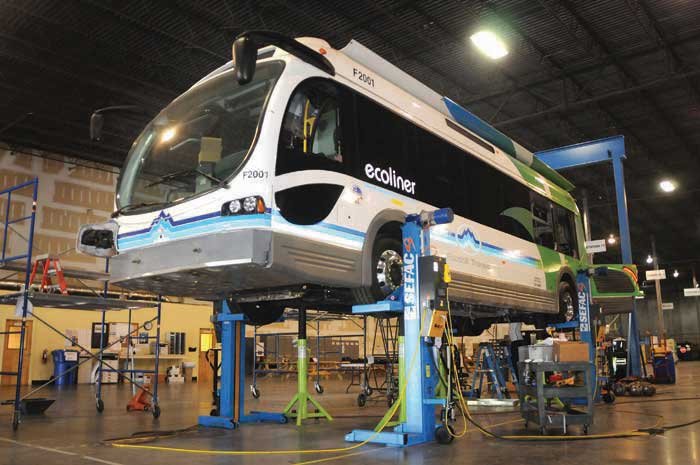
The announcement of the sale of buses and a charging station to StarMetro, the Tallahassee, Fla., transit agency, was made Monday at the American Public Transportation Association EXPO in New Orleans. The deal has been anticipated since mid-summer.
At that meeting, Proterra introduced its new CEO, David Bennett, 50, a former Eaton Corp. vice president.
Eaton is a global power systems provider.
Bennett replaces Jeff Granato, who left the company in August.
In a telephone interview with the Journal from New Orleans, Marc Gottschalk, general counsel and director of business development, said Proterra has made Greenville “our headquarters, our one and only location. We are shutting down Colorado.”
Corporate offices had been in Golden while assembly has been in Greenville, which won the work in a nationwide site search two years ago.
When new investors entered the company in July, the company said it made little sense to keep offices in Colorado.
Bennett and other executive officers, except Gottschalk, who will remain in California, are relocating to Greenville. Bennett is moving from Ohio.
Proterra is in “a rapid hiring mode” to build up the assembly and engineering staff at its facility on Whitlee Court.
The current level of employment is in the 80s but changing on the upside daily, Gottschalk said.
Gottschalk said Proterra is delaying until the end of 2012 a decision on building a plant on the CU-ICAR campus, which was the original intent after one year of city-paid lease on the Whitlee property.
Financial problems forced the new building to the back burner.
“At this point, we have a three-year lease on our current space. It is plenty large for our current build plans,” he said. The company needs to scale up production before building at CU-ICAR, he added.
StarMetro’s purchase of the three EcoRide buses is subsidized by a federal grant of $5 million under a U.S. Department of Transportation program to encourage metro systems to switch from diesel to electric buses to reduce air pollution.
Under DOT’s Transit Investments for Greenhouse Gas and Energy Reduction (TIGGER), the federal government pays 80 percent of the roughly $1-million cost of a Proterra bus. TIGGER was funded as part of the Obama administration’s economic recovery effort.
Proterra is in the catbird seat under TIGGER because it has the only commercially available 35-foot battery-charged bus on the market that meets federal standards.
Gottschalk said several agencies, including ones in Reno, Seattle and Chicago, have approved grants from 2010 funding but have yet to publicly call for bids, and “roughly 12” agencies are in the running for grants under this year’s round of funding.
“Those are grants we would have the opportunity to apply for with a strong belief we would have some success,” said Gottschalk.
Gottschalk said the price of a bus under contracts with transit agencies has ranged from $1 million to $1.2 million; but “when we get the larger volume orders, that price will come down substantially, and it is down substantially.”
As a start-up company with new technology, he said, Proterra now relies on government grants to build volume but the goal “is to drive down price to reach a point where (an EcoRide) can be purchased in a regular procurement cycle where you don’t need those grants going forward.”
Proterra claims a fully loaded EcoRide bus gets equivalent miles per gallon of 18 to 29 compared to a diesel bus, produces zero emissions, can be fully charged in less than 10 minutes and achieves savings “greater than $400,000 in total lifetime operating expenses.”
Front office shuffling at Proterra began in July when the equity firm of Kleiner Perkins Caufield & Byers led a group of major investors, including a green-energy arm of General Motors, in a $30-million investment to keep Proterra alive.
Proterra, which was an innocent recipient of the ill-gotten gains of its fraud-convicted major investor, came close to bankruptcy, and Greenville residents and the South Carolina Research Authority contributed $500,000 to help meet payroll while Proterra waited for the new investment to close.
When the deal was done, the Kleiner group, which effectively bought majority control, replaced Proterra founder Dale Hill on the board and stripped Granato of his title as CEO, although he temporarily remained president for a few weeks.

AUGUST 11, 2011 10:34 a.m. (0)
JULY 28, 2011 11:11 a.m. (0)
MAY 5, 2011 11:08 a.m. (0)
| Comments |
|
3.26 Copyright (C) 2008 Compojoom.com / Copyright (C) 2007 Alain Georgette / Copyright (C) 2006 Frantisek Hliva. All rights reserved."


Business Licenses
City Elected Salaries
City Salaries
College Crime Report
County Elected Salaries
County Salaries
Court Dockets
Crime Blotter
Death Row
Drug Money
Executed
Expulsions
Family Court Filings
Lottery Money
Most Wanted
Nursing Homes
Out of School
Suspensions
Pardons
Parole Hearings
Political Contributions
Recent Recalls
Restaurant Inspections
SC DOT Cameras
School Profiles
School Salaries
Searchable Zoning Map
Sex Offenders
State Public Salaries
State Staff Salaries