
Posts Tagged ‘photography’

Cindy Landrum

Goodbye, Wilma

by Cindy Landrum

No Comments    |   Email to Friend    |   Print    |   RSS 2.0
Aug
1

eagleFor each of the past three summers, I’ve participated in the Grandfather Mountain Nature Photography Weekend.
For those who don’t know, Grandfather Mountain, about 70 miles from Asheville near Boone and Blowing Rock, is a 720-acre privately-held nature preserve, the only privately-held property to be designated as an International Biosphere Reserve.

North Carolina owns 2,500 acres of the mountain’s undeveloped backcountry and operates it as a state park.

Part of the attraction is the animal habitat area. The habitat provides as wild a setting in which many of the visitors will ever see such animals live.

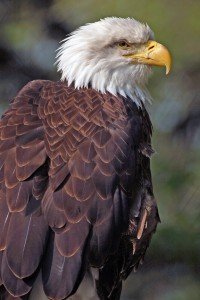
Wilma, a bald eagle who came to Grandfather Mountain in 1981 after being shot out west, was one of the habitat’s residents.

Wilma was at least 34 years old and had called the Grandfather Mountain animal habitat home longer than her habitat neighbor, Morely the golden eagle, the cougars, the bears, the deer and the river otters.

She was also one of the first subjects I photographed on each of my trips to the mountain.

I’ve always though there was something majestic about bald eagles. And Wilma, even though her injury left her without a wing and unable to fly, spent a lot of time sitting on one of the many perches in her habitat looking as majestic as any other.

But Wilma won’t be there the next time I visit Grandfather Mountain. She had to be put to sleep last week because of bad arthritis and declining health.

Sure, there will be other wonderful images to get on the mountain. But I know one I’ll miss.

Cindy Landrum

Photography happening at the zoo

by Cindy Landrum

No Comments    |   Email to Friend    |   Print    |   RSS 2.0
Feb
25

20100220-20100220-_DSC1440

It only takes a trip to the zoo.

A trip to the Greenville Zoo or the Riverbanks Zoo in Columbia costs a few dollars compared to a few thousands of dollars for a trip to Tanzania.

The animals at the zoo are often better photographic subjects because they are in better condition since they don’t have to fight for their food or find shelter.

At zoos, you are more likely to get the animal in the right pose or even see the animal at all.

Some tips:

Go early or stay late. The best light for photography is in the early morning or a couple hours before sunset. The animals are usually more active in the morning when it’s cooler. Save the indoor exhibits for photographing in the mid-day when the light is harsh.

Focus on the eyes. The eyes are the focal point and they must be in focus.

When shooting through the fence, get as close to the fence as possible. Use a telephoto lens and zoom in as far as you can. Shoot wide open, using the largest aperture (which actually is the smallest numbered f-stop) to get a shallow depth of field. Even if the fence is visible in your photo, it won’t be as noticeable.

When shooting through glass, change your angle of view until most or all of the glare disappears. If you have to use flash, it’s best to use it off-camera so you can hold it at an angle.

Be patient.

Cindy Landrum

Break out

by Cindy Landrum

2 Comments    |   Email to Friend    |   Print    |   RSS 2.0
Feb
9
6053_1182895418634_1415677306_534361_1676526_s

Guess what this is.

Nobody gets hurt.

That’s what happens when photographers break out of their comfort zones and experiment with something new, former professional jazz musician turned nature photographer Tony Sweet told a group of nature photographers meeting in Greensboro, N.C., last weekend.

While many nature photographers prefer a literal style of photography, Sweet incorporates the improvisational, spontaneous and abstract nature of jazz into his image.

Sweet, who has been named a Nikon Legend Behind the Lens, uses a slight movement of the camera to give a landscape image a painterly feel. He uses a Lensbaby to give a flower shot a soft, mostly out-of-focus look. And he uses computer software to turn a blasé, otherwise pretty unusable image into fine art.

And he makes it work.

I’m sure many of the photographers who attended the Carolina Nature Photographers Association annual meeting will be inspired to try something new or use a technique they’ve never tried before because of Sweet’s presentation. I know I will.

After all, in the digital age of photography, a press of a button on the back of the camera erases all evidence of experiments that don’t work.

And, as Sweet says, nobody gets hurt.

Cindy Landrum

Winter

by Cindy Landrum

3 Comments    |   Email to Friend    |   Print    |   RSS 2.0
Jan
27
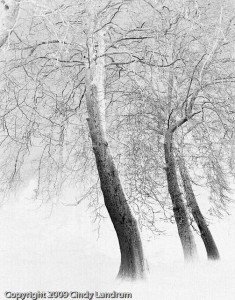
To put it bluntly, I hate winter.
The short days, biting winds and more-often-than-not gloomy skies just make me want to hibernate.
My first inclination is to grab a blanket and a book, and pass the time on my couch until the first wild flower blooms.
Instead, I grab my camera instead. OK, sometimes I have to force myself to grab my camera and head out in the very weather I tried to escape 25 years ago when I moved to South Carolina.
Why? Because I have found winter a wondrous season for photography.
It’s the one season color takes a back seat.
Instead, shape, texture and tones go to the forefront.
Winter is a season that promotes seeing because its natural color range is so limited.
I have found it to be a perfect time to go black and white. It may take a little practice to get it just right because the camera’s meter will naturally underexpose snow. Filters can help. Polarizers can deepen skies and add pop and contrast to clouds, while graduated neutral density filters can help images with large tonal ranges.
It’s amazing how winter changes the landscape.
It’s enough to get me, a winter hater, out of the house.

webtree

The short days, biting winds and more-often-than-not gloomy skies just make me want to hibernate.

My first inclination is to grab a blanket and a book, and pass the time on my couch until the first wildflower blooms.

Instead, I grab my camera. OK, sometimes I have to force myself to grab my camera and head out in the very weather I tried to escape 25 years ago when I moved to South Carolina from Wisconsin.

Why? Because I have found winter a wondrous season for photography.

It’s the one season color takes a back seat.

Instead, shape, texture and tones go to the forefront.

Winter is a season that promotes seeing because its natural color range is so limited.

I have found it to be a perfect time to go black and white. It may take a little practice to get it just right because the camera’s meter will naturally underexpose snow. Filters can help. Polarizers can deepen skies and add pop and contrast to clouds, while graduated neutral density filters can help images with large tonal ranges.

It’s amazing how winter changes the landscape.

It’s enough to get me, a winter hater, out of the house.

Cindy Landrum

The world of photography uncovered

by Cindy Landrum

4 Comments    |   Email to Friend    |   Print    |   RSS 2.0
Jan
21
blog riverplace

RiverPlace in downtown Greenville


I was looking for something to fill the void left after my kids had grown and left home.

I bought a digital camera so I could rediscover photography, an interest I had ignored for the better part of two decades save the predictable snapshots from a point-and-shoot camera documenting birthday parties, youth soccer games and the Christmas gift-opening frenzy.

During the past three years or so, photography has occupied my time and money. But photography has done so much more.

Ironically, after I started looking through the small rectangular viewfinder of my Nikon D300, I actually began noticing so much more of the world around me and seeing its beauty.

Sometimes, beauty is presented in an obvious and awe-inspiring way. Who can deny the beauty of a fog-filled valley, the view from the overlook at Caesar’s Head or even a precious baby?

Other times, we have to search for it in items often we otherwise overlook as we hurry from one meeting to the next, or running from one kid’s soccer game to the other’s dance class.

Although it can be way beneath the surface, there is beauty somewhere in that decaying building, that reflection, that aged face.

Looking through the viewfinder has forced me to slow down and really see. It’s something I do now even without a camera in my hands.

And I like what I see.